How to Streamline Software Testing — 5 Practical Steps
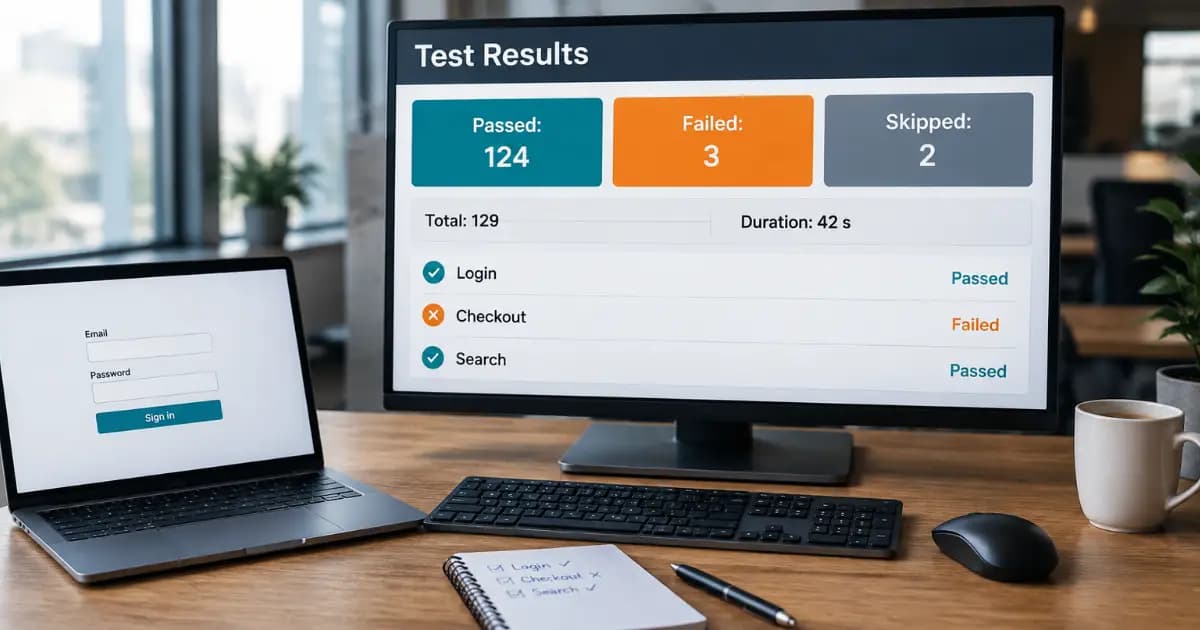
Software testing gets faster and more reliable through four complementary approaches: moving tests earlier in the development cycle (shift-left testing), prioritizing tests by business risk instead of testing everything equally (risk-based testing), running the right tests on every code change (continuous testing), and automating repetitive regression scenarios. Combined with clear roles across the team, these genuinely shorten release time without cutting corners on quality — and none of them require a tooling revolution, just a different order of work.
See how we approach website development and scaling IT teams at Codari — testing is one stage of the same process.
Why does testing slow down releases?
The most common problem isn’t a lack of tests — it’s where testing sits in the process. When testing only starts after a feature is „done,” every bug found sends the developer back to code they’ve already moved on from, and the fix costs more time than catching it in the first place. The second problem is testing everything equally: a team spends as much attention on a rarely-used feature as on the checkout screen, instead of concentrating effort where a bug would actually hurt.
What is shift-left testing and how do you implement it?
Shift-left testing means moving testing earlier in the cycle — instead of waiting for a finished feature, tests are designed alongside the code, and some of them (unit tests, static analysis) run automatically on every push. In practice, implementation starts with three steps: making unit tests for new code part of the standard definition of „done,” adding a linter and static analysis to the CI pipeline, and involving testers in sprint planning rather than only at the end of it.

Photo: Luca Bravo / Unsplash
What is risk-based testing and when should you use it?
Risk-based testing prioritizes tests by business risk rather than by backlog order. The team first identifies which features have the biggest impact on the user or on revenue (payment, login, order placement), then allocates testing time proportionally to that risk. This works best when there’s limited time for testing before a release — instead of shallow coverage everywhere, the team goes deep where a bug would actually hurt.
What does continuous testing actually mean?
Continuous testing means running the right set of tests on every code change, not just once before release. In a CI/CD pipeline this usually means three layers: fast unit tests on every push, integration tests on every merge to the main branch, and a full (often partly automated) regression pass before release. Bugs surface within minutes instead of weeks after the change was introduced — which directly shortens the time needed to fix them.
What should you automate first in software testing?
- Regression tests for key paths — login, payment, checkout — because they repeat at every release and manually clicking through them is the most expensive part.
- API tests — cheaper to maintain than UI tests and less brittle against small interface changes.
- Unit tests for new code — as a standard, not an afterthought at the end of a sprint.
- UI tests last — the most expensive to maintain, so only automate the scenarios that genuinely recur.
Which testing approach should you choose? Comparison
| Approach | What it involves | Biggest benefit | Best fit |
|---|---|---|---|
| Shift-left testing | Testing alongside coding, not after it | Bugs caught before they get expensive | Teams shipping frequent releases |
| Risk-based testing | Prioritizing tests by business risk | Maximum coverage where it matters most | Limited time before release |
| Continuous testing | Tests run on every code change | Bugs surface in minutes, not weeks | Teams working in CI/CD |
| Regression automation | Scripts instead of manual clicking through repeat scenarios | Team time goes to new features, not repeats | Large-scale projects with frequent releases |

Photo: Kaleidico / Unsplash
In practice, these four approaches are rarely picked in isolation — most teams combine shift-left with risk-based (to know what to test early) and add regression automation once the project has grown enough that manual clicking stops paying off. If you’re building a testing process from scratch, take a look at how we work on implementations — testing is part of the same cycle for us, not a separate stage tacked on at the end.
FAQ
How much does catching bugs earlier actually save? The cost of fixing a bug grows with every stage it goes undetected — a bug found while writing code costs a fraction of the same bug found by a user in production, once you factor in diagnosis time, a hotfix, and often lost customer trust.
Does test automation replace manual testers? No — automation takes over repetitive regression scenarios, but exploratory testing of new features, usability judgment, and edge-case testing still need a human. A good team combines both instead of picking one over the other.
Where should you start if your company has no testing process at all? With risk-based testing on the most important paths (payment, registration, the core product feature) and basic unit tests for new code — a full CI/CD pipeline can be built out later, but these two give the fastest return.
Should a small app be tested as rigorously as a large system? Testing scale should be proportional to risk, not to codebase size — a small app that handles payments needs solid tests despite its size, while a large internal admin panel with low risk can get away with lighter coverage.
Is testing in your project a mess, with releases constantly slipping? Get in touch — we’ll walk through your current process and show you where you can genuinely speed things up.
 See alsoGet in touch
Let's talk
Let's build
something great.
Do you have a vision you want to bring to life? Or perhaps you need support in growing your business? Trust the experts at Codari!
What do you gain?
- IT solutions tailored to your needs.
- Direct support from our experienced specialists.
- Ideas that drive your success.
Your journey to digital transformation starts here!